Listening to the Planet: Highlights From the World Ecoacoustics Congress
Researchers and ecologists at the World Ecoacoustics Congress are using audio data and open digital infrastructure to monitor biodiversity and protect Australia’s changing ecosystems.
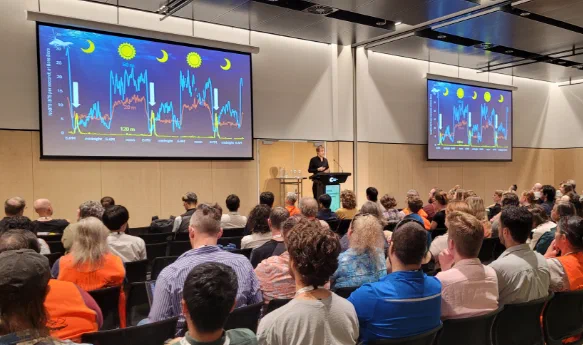
From forest soundscapes and threatened bird calls to the subtle audio cues of changing landscapes, ecoacoustics is transforming how we monitor biodiversity. At the recent World Ecoacoustics Congress (WEC), held in Cairns (Gimuy) from 17 to 20 August 2026, acoustic researchers, data scientists, field ecologists and conservationists gathered to share cutting-edge research and explore how audio data can help protect our environment.
Organised by James Cook University, Museums Victoria, QUT and Adelaide University in partnership with national and international organisations, WEC showcased how non-invasive passive acoustic monitoring (PAM) delivers rapid, real-time insights into ecosystem health and wildlife recovery across Australia and globally.
ARDC-Co-Invested Projects Lead Workshops and Technical Sessions #
Hands-on workshops were a major highlight of WEC, equipping delegates with practical skills and open digital infrastructure to manage large-scale audio datasets. ARDC-co-invested projects led key sessions demonstrating national research infrastructure in action:
- Open Ecoacoustics
: We hosted intensive workshops on managing continuous, long-term audio data streams. Participants explored how to build, test and run automated call recognisers using the Ecosounds platform under the leadership of Dr Phil Eichinski (QUT). Dr Anthony Truskinger (QUT) led delegates on how to upload raw audio recordings, process those data, annotate, and share data as wanted alongside national datasets. The sessions demonstrated standardised workflows and open repositories that make ecoacoustic datasets Findable, Accessible, Interoperable and Reusable (FAIR). - EcoCommons Australia
: Dr Ryan Newis and Dr Renee Piccolo (QCIF Digital Research) from EcoCommons delivered hands-on training showing how researchers can seamlessly integrate acoustic occurrence data into spatial and ecological workflows. Workshop participants accessed over 50,000 curated environmental datasets to build and run Species Distribution Models (SDMs) across 19 different algorithms. The sessions highlighted how combining passive acoustic data with EcoCommons cloud infrastructure accelerates biodiversity modelling, occupancy analysis and climate impact forecasting.
Broader technical and ethical workshops at the congress provided delegates with practical skills across the entire ecoacoustic research lifecycle:
- Acoustic Localisation: Specialised technical sessions introduced state-of-the-art methods for 3D acoustic localisation. Frontier labs’ Kieran Aland led participants in learning how multi-microphone arrays and spatial algorithms pinpoint exact wildlife positions in dense terrestrial and aquatic environments.
- Listening on Country and Ecoacoustic Ethics: Dr Leah Barclay (University of the Sunshine Coast) led the workshop Dandhigu Yimbana: Listening on Country and the Ethics of Ecoacoustics that explored First Nations co-design, Indigenous Data Governance, and the Collective Benefit, Authority to Control, Responsibility, and Ethics (CARE) principles. Delegates discussed how to align bioacoustic research with community priorities and respect First Nations sovereignty over ecological and cultural knowledge.
- Best Practice Guidelines: May-Le Ng (Ecoacoustics Guidelines Australia) and Dr Kristen Thompson (Queensland Government Department of the Environment, Tourism, Science and Innovation) led interactive sessions focused on establishing standardised ecoacoustic surveys and data guidelines for Australia.
- Global Networks: Professor John Quinn (Furman University) led participants in a discussion about building a global bioacoustics “network of networks” to harmonise acoustic data formats and boost international research collaboration.
Plenary Insights #
The congress featured 4 inspiring plenary speakers who demonstrated how sound science connects biological scales, evolutionary theory, human culture and environmental policy:
- Dr Xavier Raick (Aarhus University): Showed how marine soundscapes link underwater ecosystems and individual species across biological scales. His research demonstrates how acoustic cues guide reef fish recruitment and larval settlement, while biological sound patterns serve as vital indicators of coral reef health and conservation impact.
- Dr Dominique Potvin (University of the Sunshine Coast): Explored how animal communication systems evolve under environmental pressures and human disturbance. Her presentation highlighted how acoustic cultures and behavioural adaptations shape wildlife soundscapes, urging researchers to treat soundscapes as living evolutionary phenomena rather than passive environmental reflections.
- Dr Wendy Erb (Cornell University): Highlighted biocultural sound science in Indonesia, weaving together autonomous recording data with Indigenous community knowledge. Her collaborative research shows how soundscapes capture the cultural meaning of landscapes and document the impacts of wildfires, land-use change and development on both people and wildlife.
- Dr Zuzana Burivalova (University of Wisconsin-Madison): Addressed the crucial gap between collecting continuous acoustic data and driving real-world conservation decisions. Drawing from the Sound Forest Lab’s work in tropical forests, she emphasised the need for interpretable, credible and locally relevant acoustic metrics that align with post-2030 global conservation targets.
Summary of Congress Themes and Abstracts #
Beyond the plenary addresses, WEC hosted dozens of oral presentations and poster sessions organised around key thematic areas:
- Soundscape Ecology and Ecosystem Monitoring: Tracking total acoustic activity to measure forest restoration, habitat degradation and seasonal ecological shifts.
- Species Call Recognition and Machine Learning: Applying automated classifier algorithms and neural networks to identify rare and threatened species from thousands of hours of field recordings.
- Hardware, Sensors and Edge Computing: Deploying autonomous recording units (ARUs) in remote environments and testing low-power processing at the point of capture.
- Data Pipelines and Open Science: Developing standardised data management practices, open-access repositories and reproducible workflows for large-scale acoustic data which can be revisited for new insights.
You can read the abstracts in the WEC Abstract Booklet
Turning Sound into Actionable Data #
Acoustic sensors can record continuously for months, generating massive datasets that require robust digital infrastructure to analyse.
Through the Planet Research Data Commons, the ARDC works with research partners to build national platforms that store, process and analyse ecoacoustic data. By connecting field recordings with automated recognition tools on cloud infrastructure, researchers can identify species calls faster and share reliable evidence with land managers and policymakers.
Get Involved: Join the Ecoacoustics Movement #
Whether you are a field ecologist, data scientist or ecoacoustics enthusiast, you can contribute to monitoring and protecting ecosystems through sound:
- Connect with ecoacousticians worldwide by securing an International Society of Ecoacoustics membership
. - Help researchers identify species call recordings on Call Detective
(an Open Ecoacoustics platform). - Discover how national digital research infrastructure supports bioacoustics on Open Ecoacoustics
. - Learn how to model biodiversity data on EcoCommons Australia
.
We will be running webinars featuring plenary speakers from WEC starting later this year. Get notified of the upcoming Ecoacoustics webinars – subscribe to the Open Ecoacoustics newsletter
Written by Dr Rob Clemens (ARDC). Reviewed by Dr Nina Scarpelli (Museums Victoria), Prof. Paul Roe (JCU), Dr Anthony Truskinger (QUT) and Jo Savill (ARDC).
This article is a cross-post, reproduced with permission from the ARDC website